If you've only ever looked at the night sky from a city or suburb, you've been watching television with the volume on mute. The stars are there, technically, but the light pollution and atmospheric haze strip away everything that makes the sky extraordinary. Head to higher ground — really high ground — and the difference is staggering.
Why Altitude Matters
Every thousand metres of elevation you gain removes a significant chunk of the atmosphere between you and the stars. At sea level, you're looking through the full column of air — moisture, dust, pollution and all. At 2,500 metres, roughly 25 percent of that atmosphere is below you. The sky is darker, the stars are sharper, and objects that are invisible from lower elevations suddenly appear.
This is why the world's great observatories are built on mountains. Mauna Kea in Hawaii sits at 4,200 metres. The European Southern Observatory in Chile is at 2,635 metres. The Roque de los Muchachos in the Canary Islands is at 2,396 metres. These aren't arbitrary locations. They were chosen because altitude gives you a fundamentally better view of the universe.
The Best Mountain Stargazing Spots
You don't need an observatory to benefit from altitude. Many mountain regions offer exceptional dark sky conditions accessible to anyone willing to drive or hike. In the American West, Cherry Springs State Park in Pennsylvania and Big Bend National Park in Texas are both designated International Dark Sky Parks. In Europe, the Pic du Midi in the French Pyrenees offers stargazing nights at nearly 2,900 metres.
Closer to established cabin destinations, the mountains of Colorado, Montana and New Mexico all offer dark sky conditions within a short drive of popular rental areas. The key is distance from urban light domes — even a small town produces enough light to wash out the fainter stars.
What to Bring
Binoculars are more useful than a telescope for beginners. A decent pair of 10x50 binoculars will reveal the craters on the Moon, the moons of Jupiter and the fuzzy glow of the Andromeda galaxy. A star chart app on your phone — used briefly, with the screen dimmed — helps identify what you're looking at. And a reclining camp chair makes the difference between ten minutes of neck pain and two hours of comfortable viewing.
Dress warmer than you think you need to. At altitude, nighttime temperatures drop fast, and you'll be sitting still. Thermal layers, a hat and gloves are essential even in summer.
The Reward
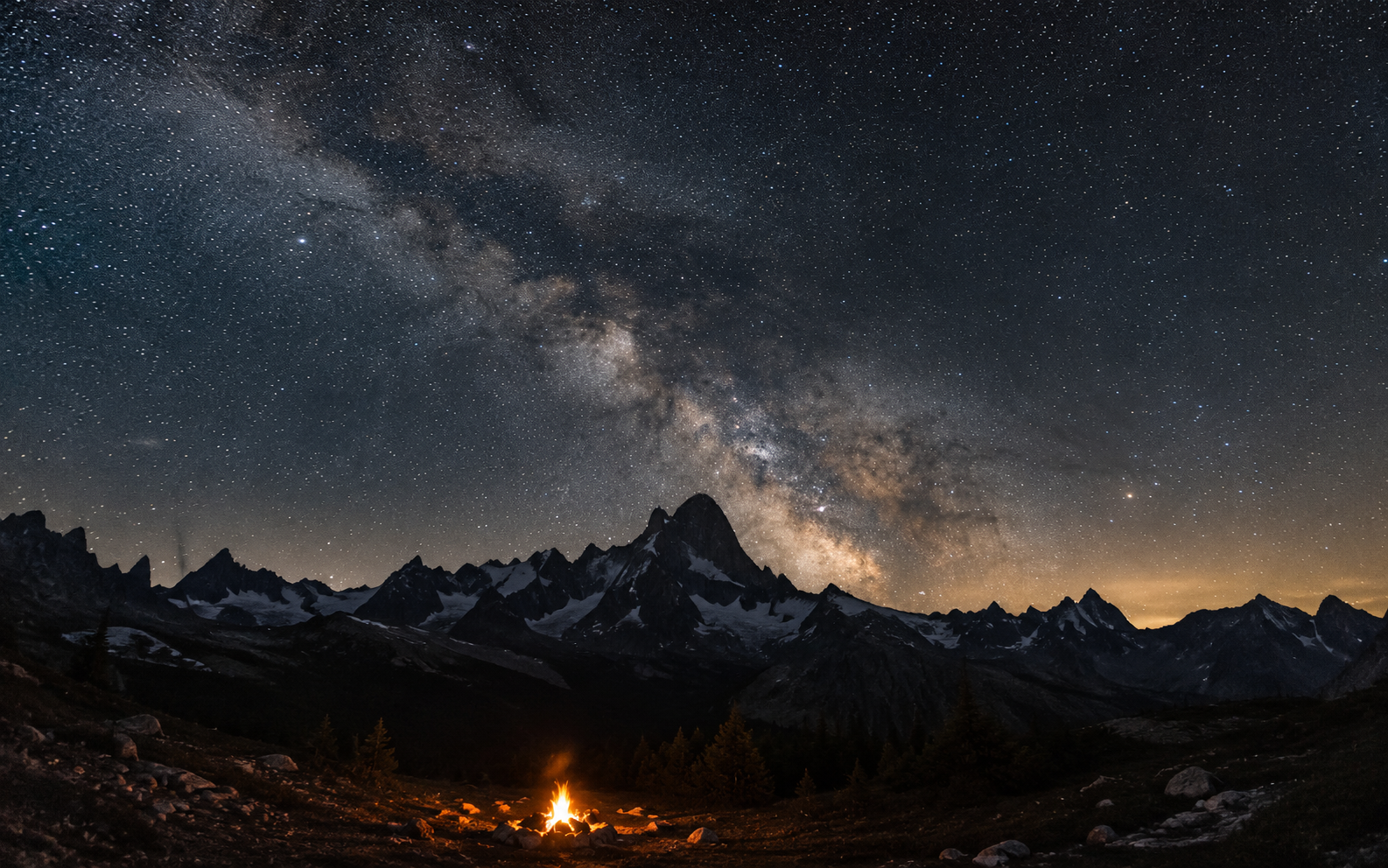
There's a moment, about twenty minutes after you settle into position, when your eyes fully adjust to the dark. The sky opens up. The Milky Way — which you might have seen only in photographs — becomes a physical presence overhead, a river of light stretching from horizon to horizon. You can see satellites crawling across the sky, meteors flaring and dying, and stars so numerous that the familiar constellations almost disappear in the crowd. It's humbling. And it's available to anyone willing to climb high enough to see it.